Thursday, March 1, 2012


Vytegra night shots


Vytegra Has Guests by Vera Terekhova
Translated by Kristina Pingston

On February 26th, for the third time, a group of students from the University of Michigan in the U.S. came to our district, headed by their leader and instructor at their institution, Alina Makin.

The foreign guests come here for Alternative Spring Break as part of the project "RUSLAN". The coordinator of their visit to the town is the honorable citizen of Vytegra, Tamara Makarova.

On February 27th, the American students acquainted themselves with the Russian heartland by going on an excursion to the district's local history museum and meeting with the town's administration. It is necessary to say that they had prepared for meeting our country, having obtained vital knowledge of it.  In the period of practically a week, the young people will participate in volunteer work. For example, in the museum they will do video work on the museum's establishment, one of the best in the province, digitize its recordings and photographs of its exhibits, and translate material on the history of our region into the English language. After that, they will put all of this information on the museum's website. They will also participate in volunteer work in Vytegra schools №1 and №2, and the school in Andoma. In addition to this, many interesting meetings and activities await them here.

Our guests' trip to Vytegra will end on March 3rd. They will be discussed in more detail in one of the issues of "The Red Flag".

The Road from Petersburg to Vytegra

I apologize that this is my first post, as it is a few days old. We have just been having the time of our lives here. I hope to give some more recent updates soon!

After exploring the culturally and historically rich center of St. Petersburg, I felt that I was in a whole as we travelled through through the stylized Soviet apartment blocks of Leningrad, and then once again as we left Leningrad and entered the Russian provinces on the way to Vytegra. The transition from Leningrad into the countryside reinforced the idea that the provinces are isolated from the capitals, as there was no transition from the enormous city into the provinces; there was literally a line that divided the two. 

Although rather abrupt, the transition from Petersburg to the provinces was exciting because it brought a feeling of peace as I looked out the window and realized that we had entered the beautiful Russian Heartland. We drove only for a few minutes, but  it felt as if we were hundreds of miles away from the bustling city of St. Petersburg. A thick forest of snow-covered birch trees lined the highway that led us deep into the Russian Heartland. It was as if we were traveling on the very road painted by the Itinerant painter Ivan Shishkin or Isaac Levitan. Only a city as unnatural and imposing as St. Petersburg could be a five minute drive in the opposite direction down this road. We drove further and further down this birch-lined road for hours and saw nothing, save a little cafe, until we reached the Monastery. The contrast from the city was reinforced by the fact that our cell phones did not get service and our modems gave really weak signals. 

Our arrival at the monastery was as abrupt as the transition away from St. Petersburg, but unlike the big city, the Monastery was not unnatural and imposing. The Monastery, while grand and magnificent, looked as if it had always belonged there. It was as if nature grew organically around the Monastery, rather than the other way around. This harmonious connection with the land made me realize why this Monastery is considered the Holiest place in all of Russia. 


Wednesday, February 29, 2012

There is a reason it's called the House of Culture

Interacting with the local high schoolers in the classrooms has rewarding, challenging, inspiring, and constructive, but sometimes you just need to have a dance-off. It's human nature. The youth organization in Vytegra organized an event at which the following occurred:


Some compelling footage, no? We have definitely left our mark on this town – as these Russian teenagers have left deep impressions on us. Two of the most frequent words heard lately – "talented" and "well-rounded." From dancing to drawing, from speaking English to crafts, these locals have demonstrated almost effortless proficiency.
In the United States, we heard a lot about individualism. We pass the word around frequently, but my interactions with Vytegrans have been a truly dramatic example of people with skills and passions, people ready to offer and flaunt their talents. On the first day, we were treated to a traditional Russian dance – and then a tango; to a rendition of ДДТ's "Осень" – and then two girls' original compositions. The variety of interests and dedication these students have to their studies and hobbies affirms that while the road from Saint Petersburg to Vytegra may not paved, it leads to somewhere unique and enthralling.

     
           On the trip from Petersburg to Vytegra we experienced the transition from center to periphery through the windows of an old creaky bus. Initially the shifts in landscape came quite quickly as we rapidly transitioned from Petersburg, to Leningrad (outer Petersburg / Soviet era apartment blocks), to the beginnings of the countryside. While we were prepared for it, many of us were struck by the abrupt change from city to country that took place on the border of Petersburg. As one student (Dennis) said “you could have a Leningrad apartment, with a provincial view”.
            Once in the country, the view from the bus window remained much the same for miles and miles. If you removed the nuanced distinctions in buildings, vehicles, and signage, the road out of Petersburg felt like it could have been in northern Michigan. Having spent a large part of my childhood “up north”, I found a certain comfort came with the view.                                
            Small pockets of houses came and went, with various lone buildings spread sparsely in between as we made our way the Alexander Svirsky Monastery. I had known from our class discussions that this was an important monastery. Yet I missed the significant detail that this was not just any monastery, but the holiest site in all of Russian Orthodoxy. Its significance is due to the appearance of the Holy Trinity to Alexander Svirsky, this being only the second time they have appeared to man. The implication of this began to sink in as we walked onto the grounds of the monastery: this is holy land. I was initially, and through the course of our visit, struck by the modest humility of this place. I have visited other places of religious importance such as Notre Dame, and St. Peters. Those were intense in a grand, and spectacular way, but the Svirsky Monastery’s stark simplicity was a sharp contrast to its religious significance. To me this contrast only served to heighten the intensity of our visit. I did find it interesting that the holiest place in Russian Orthodoxy had only about twenty monks in residence. Is this function of the decline in monastic life in general in Russia? Or does this have to do with the monastery still healing from the trauma wrought upon it during the Soviet era? While at the monastery, a group of professional singers from Moscow performed two songs for us. The cliché “you had to be there” immediately comes to mind as I reflect upon this performance. I don’t think any of us was prepared for the intensity, or the power with which these five men sang.
            Leaving the monastery with a new respect for the orthodox religion, we boarded our bus to finish the trip to Vytegra. We experienced our final transition from center to periphery after leaving the monastery and crossing the border between Leningrad and Vologda Oblasts. Almost immediately the road went from paved to a bumpy, slippery, and unpaved one. We rattled and bumped our way along for the next few hours, only stopping when our bus briefly broke down to the rapid drop in temperature. Our capable drivers quickly fixed the bus, and we finished the journey to Vytegra.
Today, I chose to work in the museum instead of in the school so that I could finish transferring one of a kind audio tapes from the museum to mp3s.  This was a welcome break from the non stop activities of the previous day, which included a visit to the local schools and the youth group, which although incredibly fun and insightful, left us all exhausted.  We were all extremely impressed by the accomplishments of the Vytegra's students, and we were very surprised to find that their English was much better than our Russian, or at least my Russian.

My guide was very insightful and I think we both learned a lot from each other.  Some of the things I learned from her included:

1) Wedding rings in Russia are worn on the right hand instead of the left and share the same myth about the blood vessel running from that finger all the way to the heart.  (I had learned this because she had asked me what my silver ring with elephants on my right hand meant)
2) Russians find it strange that Americans are always drinking water or have bottled water on them.
3) Dean Martin's "Make Me Sway" is an incredibly popular song in Russia, as well as "O Susanna"

When we went to visit with the Russian youth group, we were put to shame yet again as the kids completely destroyed us in dance battles, but as many members of our group put it, they did have the home field advantage.


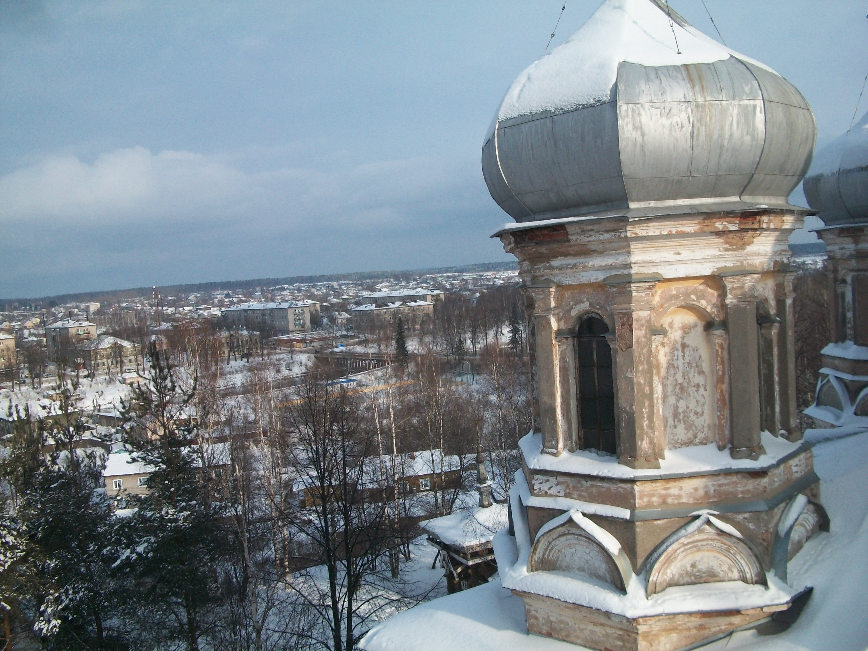
Today, however, I went to work at the museum and afterwards, joined back up with the group to visit the Klyuev museum and the church in Vytegra, shown in the pictures above.


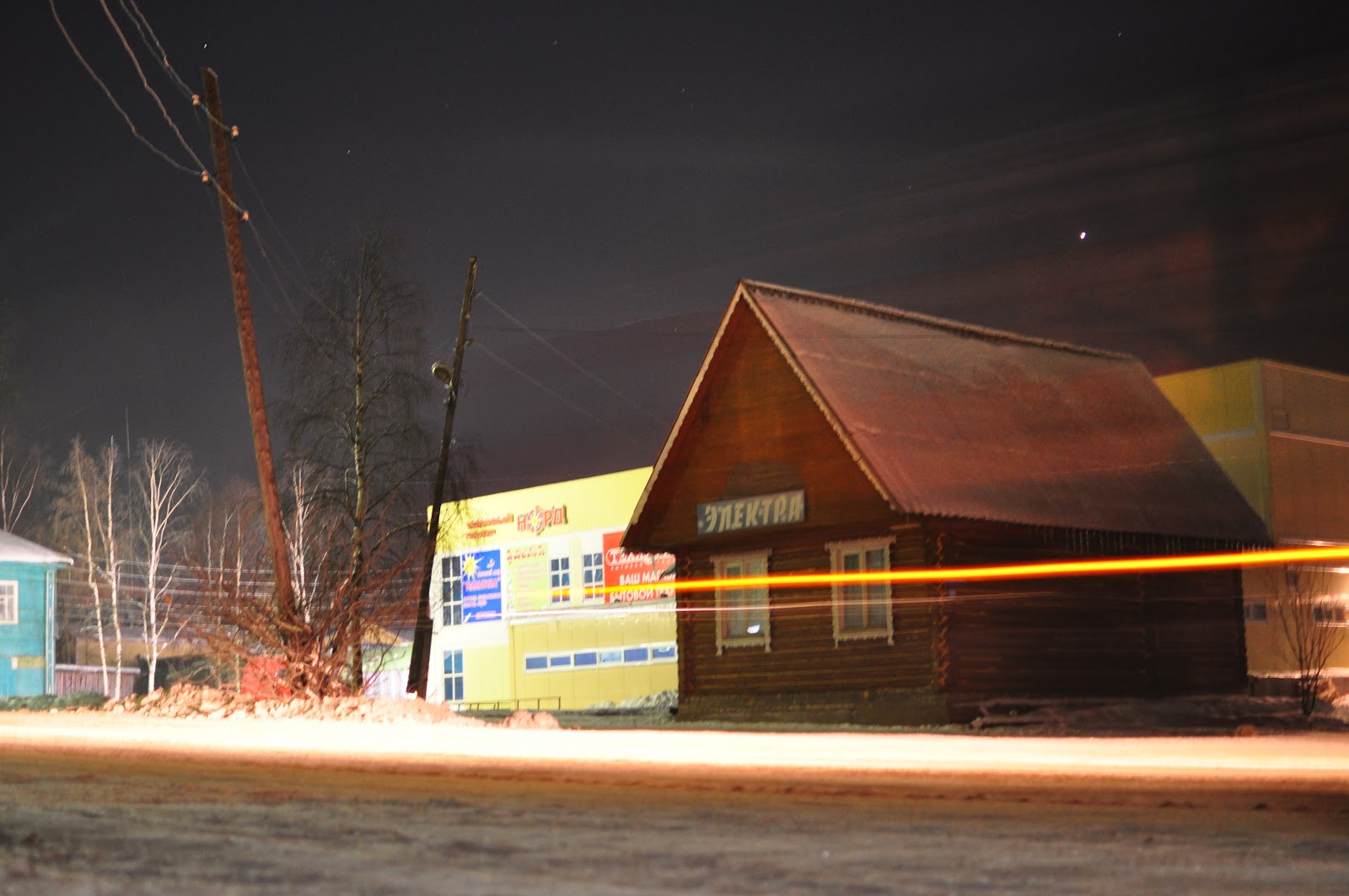
It is something wonderful to wander around Vytegra and just enjoy the local atmosphere. The air is clean, there sky has little light population at night, and the scenery is beautiful. While the snow is too loose for proper snowmen, the enjoyment gained from observing Vytegra more than makes up for it.

Vytegra is like many small towns in the United States, if incredibly more isolated. The only way to travel to this town is by vehicle and a 6-10 hour drive. The local businesses are not chains stores, everyone knows everyone else, and the children are incredibly interested in the  world beyond Vytegra's borders.

The residential and business have no direct boundaries, and in many cases the owner live behind the store front in a attached apartment.


Birch trees exist across the entire region, and the unfrozen river glistens in the moonlight. Down every steep hill is an icy track where children (and myself) have slid across the snow either on their stomach or backpack as a make-shift sled. Children walk themselves home from school here, even the young ones from the primary school. Mothers and father pull and push small children and infant in strollers that have sled feet instead of wheels.

Live is different here, and yet incredibly familiar for those that can identify with their own humble beginnings back home.